

BI & Analytics · Data Engineering (Spark & Notebooks) · Data Science & ML · Governance & Catalog
Who does what with data: every role in a company, and where they overlap
Twenty job titles, four accountabilities. A map of the technical and non-technical data roles, what each one is actually answerable for, and the five confusions that cause the most damage when nobody settles them.
The short version
- There are roughly twenty data job titles in common use and only four accountabilities: who decides, who builds, who analyses, and who assures. Every title is a bundle of those four in some proportion.
- The titles are not standardised and never have been. A "data engineer" at a 30-person company and at a bank are different jobs. Ask what someone is answerable for, not what their title is.
- The roles that go missing are almost never the engineering ones. Companies hire three data engineers before they appoint a single data owner, and then wonder why nobody can say what "active customer" means.
- The highest-value thing in this article is not the list. It is the five confusions further down — engineer versus analytics engineer, scientist versus ML engineer, owner versus steward, analyst versus BI developer, CDO versus head of data. Each one, left unsettled, produces a specific and predictable failure.
Four accountabilities, not twenty job titles
Lists of data roles usually read as an org chart with the reporting lines rubbed out. That hides the only structure that matters, which is what each person is answerable for when something goes wrong.
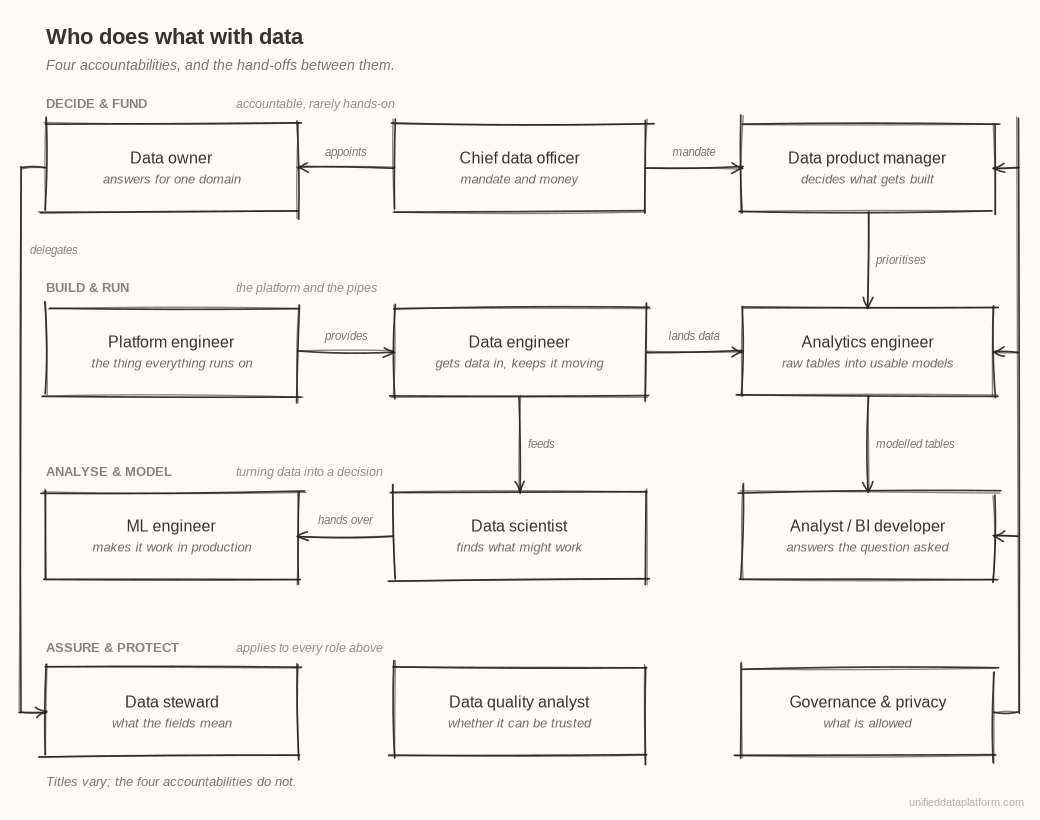
Read it as a graph rather than a hierarchy. The vertical arrows are hand-offs — things that get passed along and can be dropped. The bracket on the right is the point most org charts get wrong: assurance is not the last stage of a pipeline. It is a constraint on every stage at once, which is why drawing it as a fifth band underneath would say the opposite of what is true.
Decide and fund
Mostly non-technical. Almost always under-staffed, and almost never the thing anyone asks for first.
Chief data officer. Owns the mandate and the money. The real job is political: getting data treated as something the business is accountable for rather than something IT does. A CDO with no budget and no seat at the executive table is a decoration, and you can usually tell within a quarter.
Data owner. Answerable for one domain — customer, product, finance — and specifically for the decisions about it: what the fields mean, who gets access, what quality level is acceptable. This is a business role, not a technical one. The head of finance owns finance data. They do not need to know what a dbt model is; they do need to be the person who signs off that "revenue" means this and not that.
This is the single most commonly vacant role in a data organisation, and its absence has a signature: every definitional question escalates to an engineer, who answers it in code, and the company ends up with its business rules encoded by the people least qualified to set them.
Data product manager. Decides what gets built and in what order, and is answerable for whether anyone uses it. Treats datasets, models and dashboards as products with users rather than tickets with requesters. The test of whether this role exists: can someone tell you, without checking, which three data assets are most used and which are used by nobody?
Data programme or delivery manager. Sequencing, dependencies, vendors, migrations. Unglamorous and load-bearing. Platform migrations fail on co-ordination far more often than on technology.
Business analyst. Sits between a business process and the people building for it — eliciting what is actually needed, which is rarely what was first asked for. Distinct from a data analyst: a business analyst's output is a specification, a data analyst's output is an answer.
Build and run
The technical core, and the part of the list everybody already knows.
Data platform engineer. Builds and runs the thing everything else runs on: compute, storage, networking, identity, workspaces, cost controls, the deployment path. Their users are other data people. The clearest sign of a platform engineer who is doing it well is that nobody else has to think about the platform. The clearest sign of one who is missing is each team building its own.
Data engineer. Gets data in and keeps it moving: ingestion, replication, change data capture, streaming, the pipelines and their reliability. Answerable for data arriving, on time, in one piece.
Analytics engineer. Takes the raw tables a data engineer lands and turns them into models the rest of the business can actually use — transformation, testing, documentation, with version control and CI applied to analytics code. dbt Labs, who popularised the title, describe it as neither data engineering nor analysis but somewhere in the middle, and contrast it directly with analysis: an analyst spends their time analysing data, an analytics engineer spends theirs transforming, testing, deploying and documenting it.
Data architect. Decides the shape before it gets built: the storage layer, the table formats, the boundaries between domains, which engine does what. In small companies this is a hat, not a job, and that is usually correct. It becomes a job when the cost of changing your mind gets high enough.
DataOps / platform reliability. On-call for pipelines. Freshness, SLAs, incident response, the runbook. Often folded into data engineering, which works until the first 3 a.m. page and then does not.
Analyse and model
Data analyst. Answers the question that was asked, and is good enough at the domain to notice when it is the wrong question. The most underrated role on this list. A strong analyst who understands the business out-delivers a mediocre data scientist by a wide margin, and costs less.
BI developer. Builds and maintains the semantic layer, the reports and the dashboards other people use unaided. Overlaps heavily with both analyst and analytics engineer; the distinguishing accountability is the surface — somebody has to own what the dashboard says and keep it true.
Data scientist. Finds what might work. Statistics, experimentation, modelling, causal questions. The output is an answer or a prototype, and the honest version of the job includes being able to say "there is no signal here", which is a finding and not a failure.
ML engineer. Makes it work in production: serving, feature pipelines, retraining, monitoring, rollback. The hand-off from scientist to ML engineer is where most machine-learning initiatives quietly die, and the reason is almost never the model.
Research scientist. Genuinely novel methods, usually in a company whose product is the model. If you are not that company, you do not need this role and you probably think you do.
Assure and protect
Part technical, part legal, part diplomatic. This band applies to every role above it.
Data governance lead. Owns the framework — policies, the catalogue, the definitions, the forum where disputes get settled. Done badly it is a committee that produces documents. Done well it is the function that means two teams reporting the same number get the same number.
Data steward. Maintains what the fields mean, day to day: definitions, the catalogue entries, classifications, resolving the cases nobody anticipated. Usually a business-side role held by someone who already knows the domain, often as part of a job rather than all of it.
Data quality analyst. Answerable for whether the data can be trusted: profiling, tests, thresholds, chasing root causes upstream. Note the direction — quality problems are overwhelmingly created at the source system and merely discovered in the warehouse, so a quality function with no route back to the source systems is just a complaints desk.
Data protection officer and privacy. Under UK GDPR, designating a DPO is mandatory in three cases: processing by a public authority or body (excluding courts and tribunals acting judicially), core activities involving regular and systematic monitoring of data subjects on a large scale, or core activities involving large-scale processing of special-category or criminal-offence data. A group of companies may share one, provided they are easily accessible from each establishment, and the DPO can be an employee or engaged under a service contract. Check Article 37 against your own circumstances rather than this paragraph.
Records and information manager. Retention, disposal, legal hold. Rarely in the data team, frequently the only person who can tell you whether you are allowed to still have something.
FinOps for data. Attribution, budgets, right-sizing. Becomes a named role at about the point someone asks why the warehouse bill doubled and no one can answer within a week.
The five confusions worth settling
This is the part worth your time. Each of these is a boundary that, left ambiguous, produces a specific failure.
The pair | What actually separates them | What happens if you don't settle it |
|---|---|---|
Data engineer vs analytics engineer | Getting data in vs making it usable. Pipelines and reliability vs models, tests and documentation. | Either business logic ends up inside ingestion pipelines, or analysts write their own joins against raw tables. Both are expensive to unwind. |
Data scientist vs ML engineer | Finding what might work vs making it work in production. | Models that validate beautifully and never ship, or ship and silently rot because nobody owns monitoring. |
Data owner vs data steward | Deciding vs maintaining. The owner sets policy and signs off; the steward keeps the definitions straight. | Definitional disputes escalate to whoever is nearest, usually an engineer, and get settled in code instead of policy. |
Data analyst vs BI developer | Answering a question vs owning a surface other people use unaided. | Dashboards nobody maintains and analysts doing maintenance instead of analysis. |
CDO vs head of data | Mandate and accountability across the company vs running the function that delivers. | Either a CDO with no delivery capability, or a head of data being asked to set company-wide policy they have no authority to enforce. |
On owner versus steward, a word of caution about the literature. The clean three-way split you will see quoted everywhere — owner decides, steward maintains, custodian operates the systems — is a practical convention, not a published standard. DAMA's own change notes to DMBOK 2 record that terms like owner, custodian and trustee are used as synonyms for people carrying out steward-like functions, and DMBOK 2 defines stewardship more clearly than it defines "steward". The UK government's guidance on data ownership draws the custodian line more sharply, as the party that captures, stores and disposes of data according to the owner's requirements.
The practical consequence: do not cite a standard at your colleagues. Write down what the three words mean in your organisation, get the owners to agree to it, and move on. The agreement is what does the work, not the taxonomy.
What you actually need, by size
Roles are bundles. At small sizes one person holds several; the question is which bundles split first.
Company size | What typically exists | What is usually missing and shouldn't be |
|---|---|---|
~20 people | One or two generalists doing ingestion, modelling and dashboards | Named data owners. Costs nothing and prevents the definitional mess that is expensive later. |
~200 people | Data engineers, analysts, a platform person, maybe a scientist | A data product manager, and a quality function with a route back to source systems. |
~2,000 people | All of the above, specialised, plus governance | Someone senior who can actually enforce policy across domains, and FinOps before the bill becomes a board question. |
Where this goes wrong
Three failure modes, in rough order of how often I see them.
Hiring the technical bundle and skipping the accountable one. Three engineers and no owner. The engineers become the de facto owners, which they did not sign up for and are not positioned to do, and every definitional question becomes a ticket.
Treating assurance as a stage. Governance bolted on at the end, after the platform is built and the dashboards are live. By then the definitions are already inconsistent in production, and fixing them means changing numbers people have been reporting to the board.
Title inflation as a substitute for scope. Renaming analysts to data scientists, or appointing a CDO with no budget. It solves a retention problem for two quarters and a credibility problem for nobody.
The common thread is that all three are organisational failures that get diagnosed as technical ones — which is why they tend to be answered with a new tool, and why the new tool does not help.
The one question to ask
When a data initiative is in trouble, the fastest diagnostic is not architectural. It is: for each of the four accountabilities, name the person. If you cannot name someone for decide or for assure, you have found the problem, and it is not going to be solved by changing platform.
Tags: roles, careers, team-structure, data-governance, data-engineering, analytics-engineering, data-stewardship, operating-model